
| Date | Event | Time |
|---|---|---|
| 01 | Mercury at highest altitude in evening sky | --- |
| 04 | Mercury at greatest elongation east | 12:39 p.m. |
| 05 | Moon at Apogee (Distance = 404,561.904 km) | 10:29 a.m. |
| 16 | Close approach of the Moon and Saturn | 03:21 p.m. |
| 16 | Conjunction of the Moon and Saturn | 06:31 p.m. |
| 20 | Moon at Perigee (Distance = 368,087.526 km) | 09:55 p.m. |
| 22 | Conjunction of the Moon and Venus | 03:25 a.m. |
| 23 | Conjunction of the Moon and Jupiter | 12:19 p.m. |
| 29 | Close approach of the Waxing Crescent Moon and Mars | 02:30 a.m. |
| 29 | Conjunction of the Waxing Crescent Moon and Mars | 03:45 a.m. |
| 30 | α-Capricornid meteor shower (ZHR = 5) | --- |
| 30 | Southern δ-Aquariid meteor shower (ZHR = 25) | --- |

|
First Quarter | |
| Jul 03 | 03:30 AM | |

|
Full Moon | |
| Jul 11 | 04:37 AM | |

|
Last Quarter | |
| Jul 18 | 08:38 AM | |

|
New Moon | |
| Jul 25 | 03:11 AM | |
| Date | Mercury | Venus | Mars | Jupiter | Saturn | |||||
|---|---|---|---|---|---|---|---|---|---|---|
| Rise | Set | Rise | Set | Rise | Set | Rise | Set | Rise | Set | |
| Jul 01 | 07:26 am | 08:13 pm | 02:36 am | 03:17 pm | 09:46 am | 10:09 pm | 05:12 am | 06:07 pm | 11:26 pm | 11:29 am* |
| Jul 11 | 07:23 am | 07:59 pm | 02:39 am | 03:26 pm | 09:30 am | 09:49 pm | 04:43 am | 05:37 pm | 10:47 pm | 10:51 am* |
| Jul 21 | 06:51 am | 07:20 pm | 02:45 am | 03:36 pm | 09:15 am | 09:29 pm | 04:13 am | 05:07 pm | 10:07 pm | 10:11 am* |
| Jul 31 | 05:48 am | 06:17 pm | 02:53 am | 03:47 pm | 09:01 am | 09:09 pm | 03:43 am | 04:37 pm | 09:27 pm | 09:31 am* |
* = following day
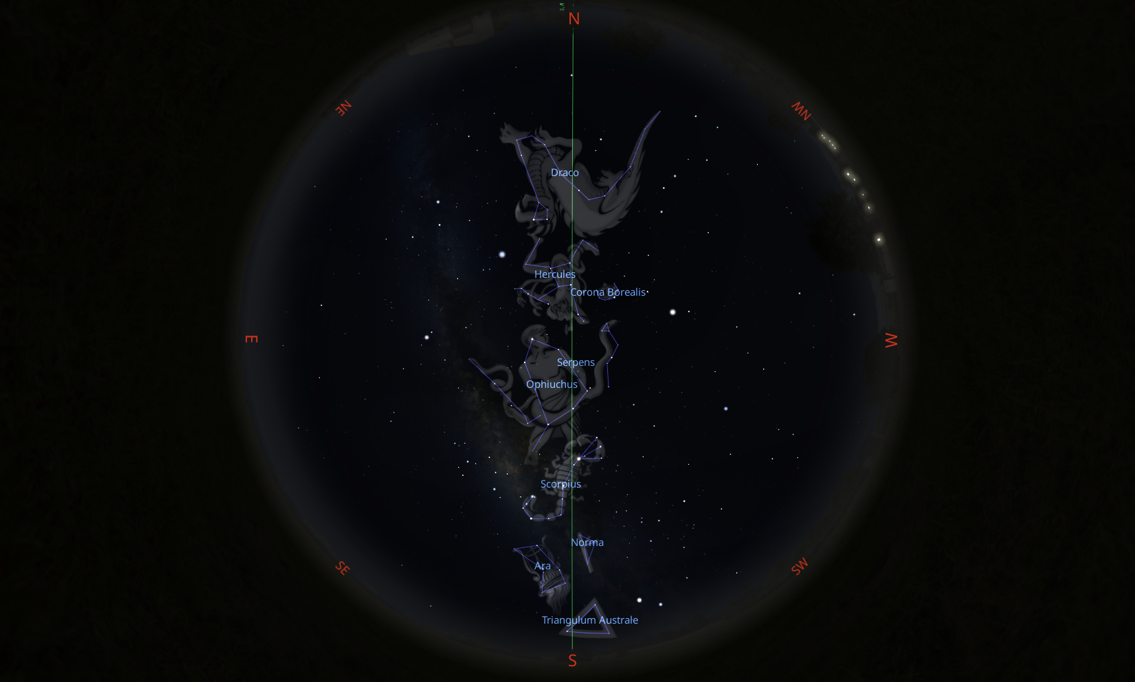 Figure 1: The view of the night sky featuring the prominent June constellations at 09:00 p.m. on 15 June 2025 using the Stellarium software. |
The constellation Hercules, the Hero, has captivated astronomers and storytellers for centuries, with its combination of rich mythology and astronomical interest. It is the fifth-largest constellation in the sky, yet its lack of exceptionally bright stars makes it less recognizable. Its brightest star, Beta Herculis, or Kornephoros, is a yellow giant with an apparent magnitude of 2.81. Another significant star in Hercules is Alpha Herculis, or Rasalgethi, a red giant with brightness varying from magnitude 3.1 to 3.9, classifying it as a variable star. Hercules contains many noteworthy deep-sky attractions. The most famous one is the Hercules Globular Cluster (M13), one of the brightest globular clusters in the Northern Hemisphere and observable without a telescope under optimal conditions. Other deep-sky objects in Hercules are the Turtle Nebula (NGC 6210), the Hercules A Galaxy [Figure 2a], and the Hercules Cluster of Galaxies (Abell 2151), in which the interacting galaxies, NGC 6050 and IC 1179, are a part of. In mythology, the constellation represents the Greek demigod, Hercules, renowned for his strength and twelve labors. [2,3]
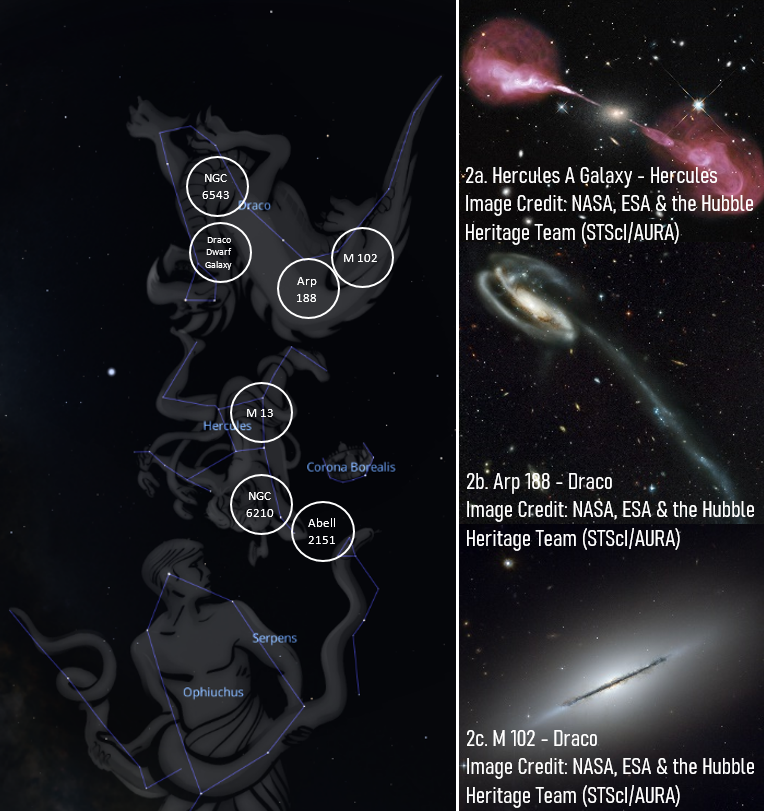 Figure 2: The northern constellations |
Draco, representing the dragon in one of Hercules’ twelve labors, is the eighth-largest constellation in the sky. Spanning an area of about 1,083 square degrees, the constellation is home to notable stars and deep-sky treasures. Eltanin (or Gamma Draconis), its brightest star, is an orange giant with a visual magnitude of 2.24. Its position played a crucial role in verifying the aberration of light. Another significant star is Thuban (or Alpha Draconis), which was once the North Star, as a result of the precession of the equinoxes. One remarkable galaxy in Draco is the Draco Dwarf, which is one of the faintest galaxies observed. Other renowned galaxies and nebulae in Draco are the Tadpole Galaxy (Arp 188) [Figure 2b], the Cat’s Eye Nebula (NGC 6543), and the Spindle Galaxy (M102) [Figure 2c]. [2,4]
Norma is a small constellation that is not among the most famous or easily visible. While its stars may not be the brightest in the sky, having no stars brighter than magnitude 4.0, interesting ones can be found in the constellation, including the T Normae, a cataclysmic variable star system renowned for its significant outbursts. Despite its lesser-known status, it serves as a host to a number of intriguing deep-sky objects. The Norma Cluster (Abell 3627) stands out as the most notable deep-sky treasure in the constellation, being one of the most massive galaxy clusters ever discovered. Other fascinating objects in Norma are the planetary nebulae, Ant Nebula [Figure 3a] and Fine Ring Nebula [Figure 3b]. [2,5] Another small and relatively faint southern constellation is Ara, the Altar. The brightest star, Beta Arae, with a magnitude of 2.84, is an orange supergiant approximately 600 light years away from Earth. Ara contains several captivating deep-sky features, such as the globular clusters NGC 6362, NGC 6352, and NGC 6397, which is notable for being one of the nearest globular clusters to Earth. Also situated within the constellation Ara is the Stingray Nebula [Figure 3c], recognized as the youngest planetary nebula discovered to date, providing crucial information on the terminal phases of stellar life cycles. [2,6]
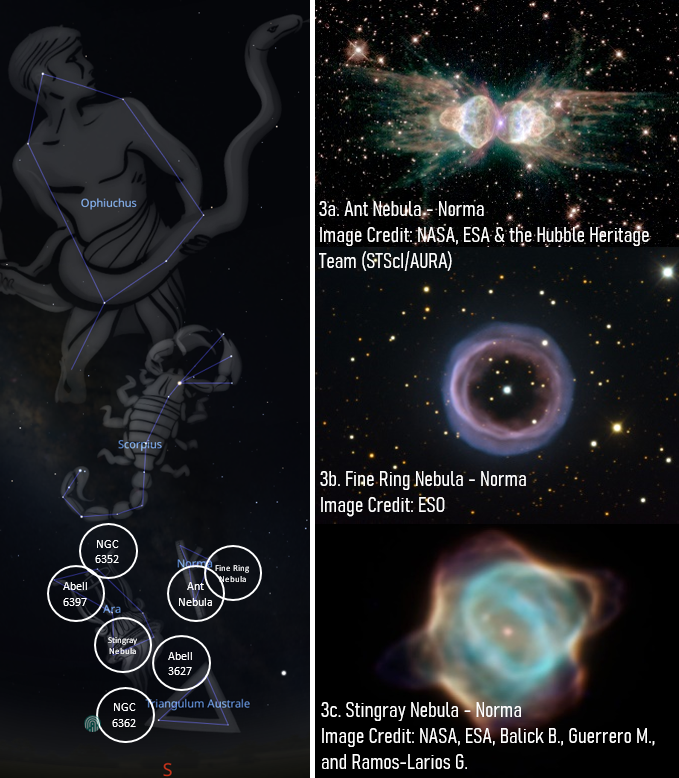 Figure 3: The southern constellations |
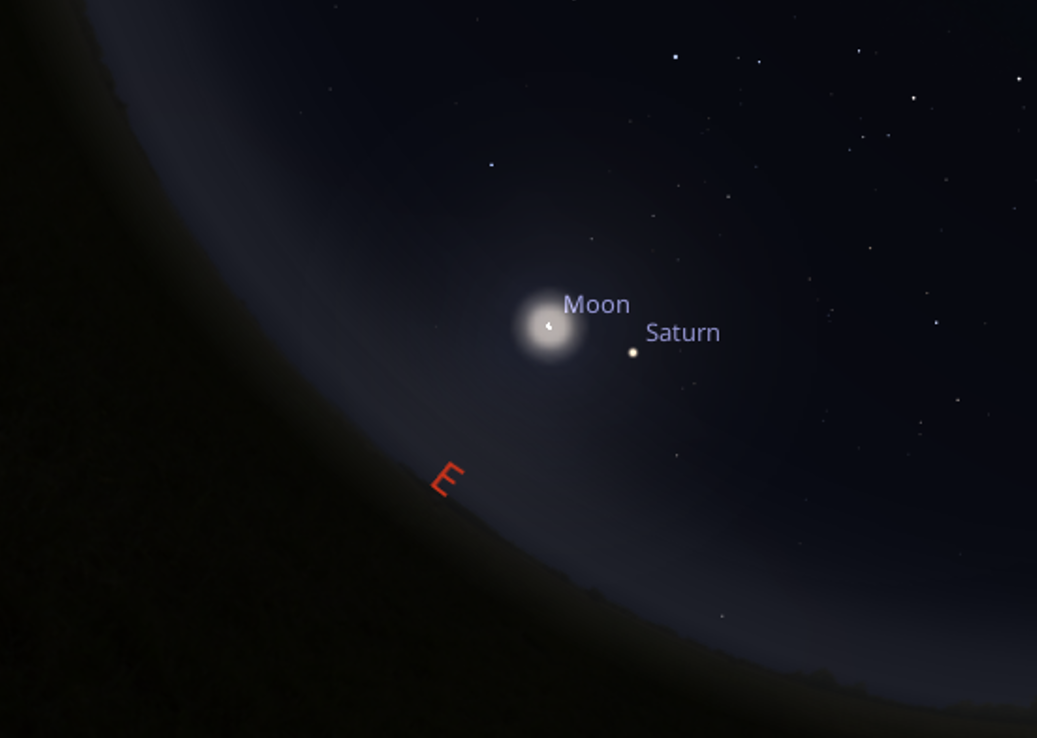 Figure 4: The view of the eastern sky showing the close pairing of the Moon and Saturn on 16 July at 11:30 p.m. using Stellarium. |
On 16 July, at 03:21 p.m., the Moon and Saturn will approach closely, passing within 3°22’ of each other. At 06:31 p.m., the two objects will be in conjunction, with the Moon passing 3°50’ to the north of Saturn. Both objects are located in the constellation Pisces. The exact occurrence of these events will not be visible as the two objects are still below the horizon, but their close pairing can be viewed at 11:30 p.m. [Figure 4]. [7,11,12]
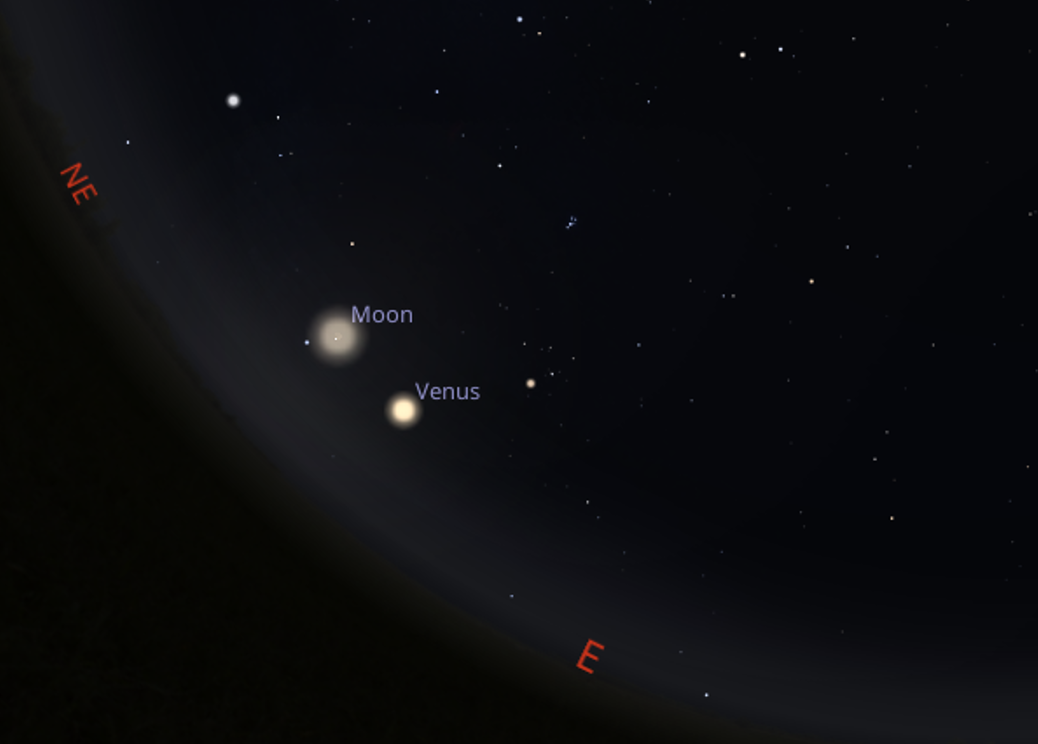 Figure 5: The view of the eastern sky showing the conjunction of the Moon and Venus on 22 July at 03:25 a.m. using Stellarium. |
On 22 July at 03:25 a.m., the Moon will pass 7°08’ to the north of Venus, as they will be in conjunction. The Moon will be shining brightly at magnitude -10.4, while Venus is at magnitude -4.0, lying behind the background stars of the constellation Taurus. The exact timing of this event will be observable in the pre-dawn sky as shown in Figure 5. On the following day, at 12:19 p.m., the Moon and Jupiter will also share the same right ascension, separated by 4°54’. Their conjunction, occurring during daytime, will not be visible, but the pair can be viewed at 04:40 a.m. until they get lost in the brightness of the Sun [Figure 6]. [7,13]
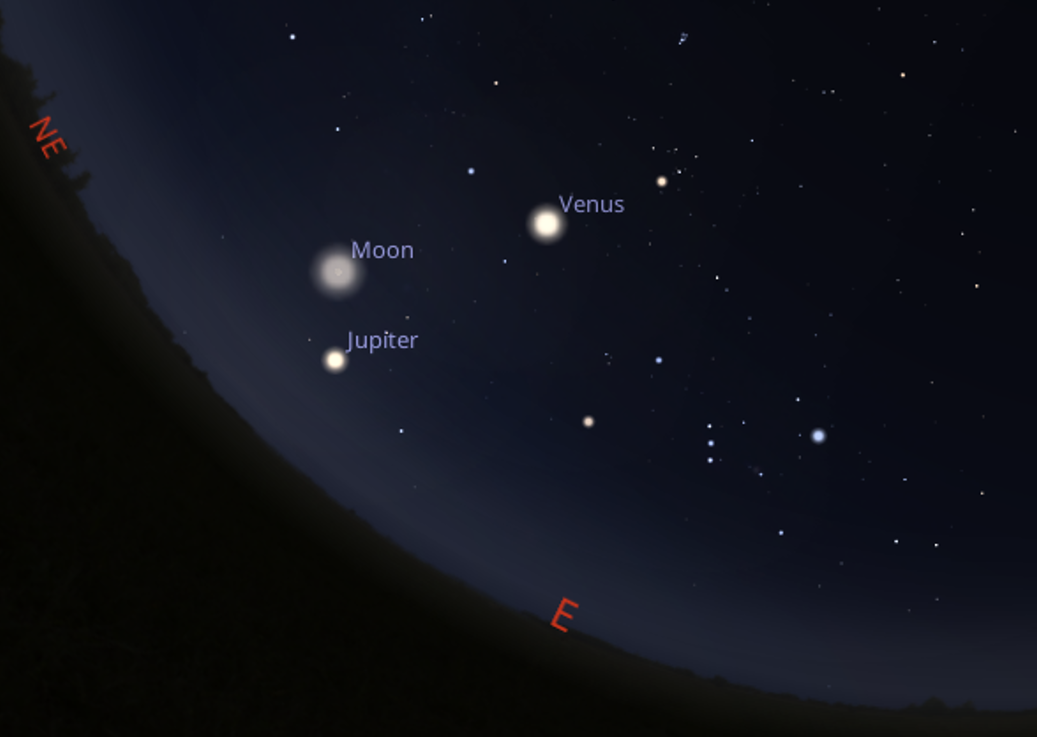 Figure 6: The view of the eastern sky showing the pairing of the Moon and Jupiter on 23 July at 04:40 a.m. using Stellarium. |
The Waxing Crescent Moon and Mars will make a close approach on 29 July at 02:30 a.m., passing within 1°07’ of each other. On the same day, at 03:45 a.m., they will be in conjunction, with the Moon passing 1°17’ to the south of Mars. The two objects are still below the horizon at the exact occurrence of these events, but their close pairing can be seen at 07:30 p.m. until they set on the western horizon [Figure 7]. [14,15] All the conjunctions and near approaches mentioned between the planet and the moon, or planet to planet, will be visible enough to fit within the field of view of a telescope and can also be viewed with the naked eye or using a pair of binoculars.
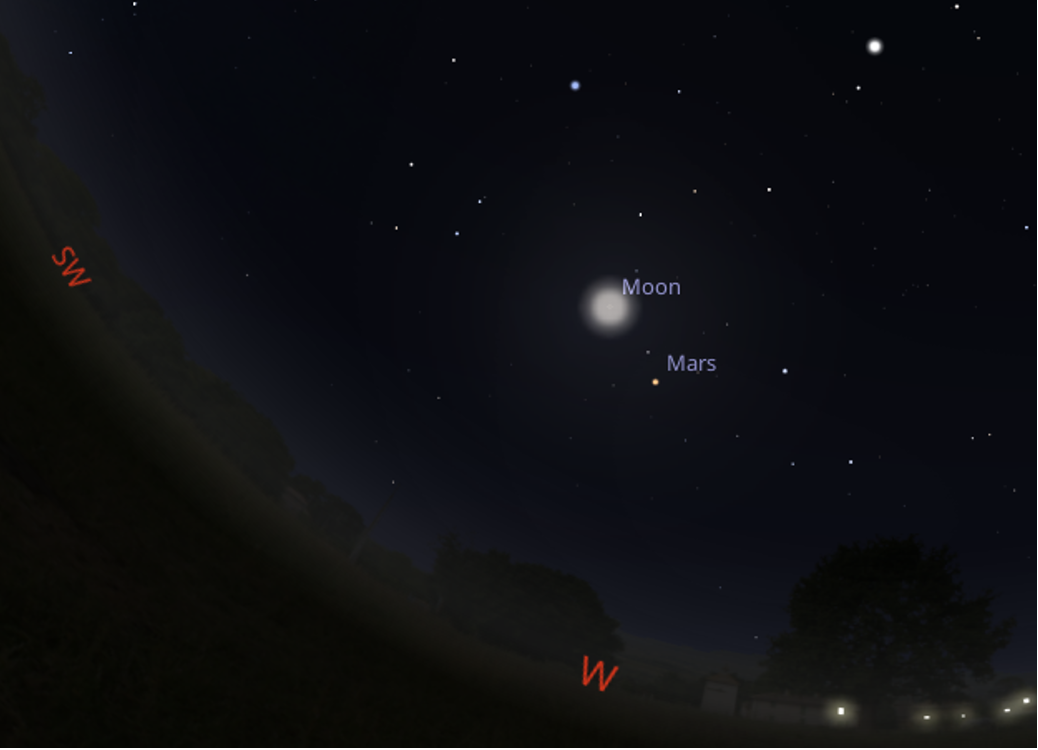 Figure 7: The view of the western sky showing the close pairing of the Moon and Mars on 29 July at 07:30 p.m. using Stellarium. |
The α-Capricornid meteor shower will be observable from 03 July to 15 August. It is produced by comet 169P/NEAT and is expected to generate about 5 meteors per hour at its peak. Capricornus, the radiant of the meteor shower, will remain above the horizon throughout the night, indicating continuous meteor activity the entire night, with its best viewing likely to be around 01:00 a.m., when its radiant is highest overhead [Figure 8]. [16]
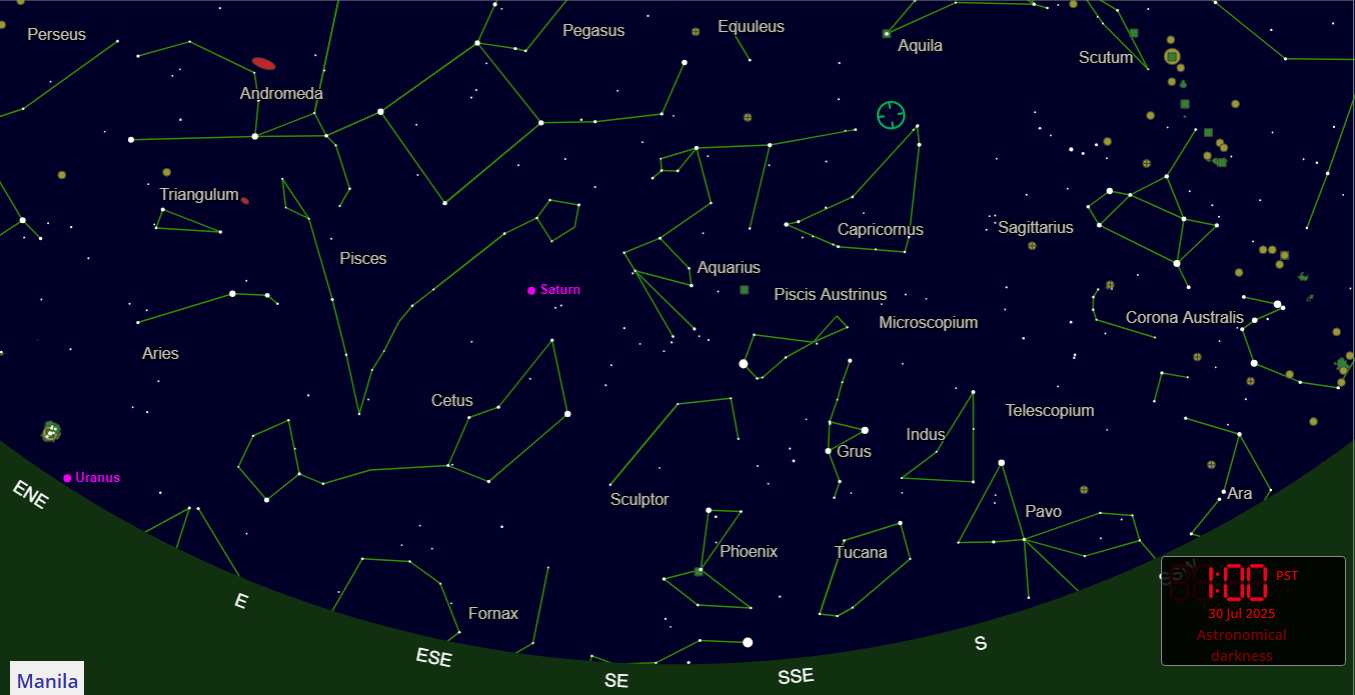 Figure 8: The view of the southern sky during the peak of the α-Capricornid meteor shower on 30 July 2025 at 01:00 a.m. when the shower’s radiant is represented by the green solid circle. |
The other meteor shower is the Southern δ-Aquariids, active from 12 July to 23 August. It originates from debris left behind by the comet P/2008 Y12 (SOHO), and its meteors appear to radiate from a point in the constellation Aquarius. At its peak, the shower can produce up to 25 meteors per hour under ideal dark-sky conditions. Rising above the eastern horizon at about 08:20 p.m. each night, the radiant of the Southern δ- Aquariids remains active until approximately 05:13 a.m. The shower is best observed around 02:00 a.m., when the radiant reaches its highest altitude in the sky [Figure 9]. With the Moon in Virgo, at about its first quarter phase, minimal interference will be present during the meteor shower observation. [17] Meteor showers are observable through the naked eye, and no special equipment such as telescopes or binoculars is needed. Maximize the viewing experience by choosing a dark observation site away from the city lights under clear and moonless sky conditions.
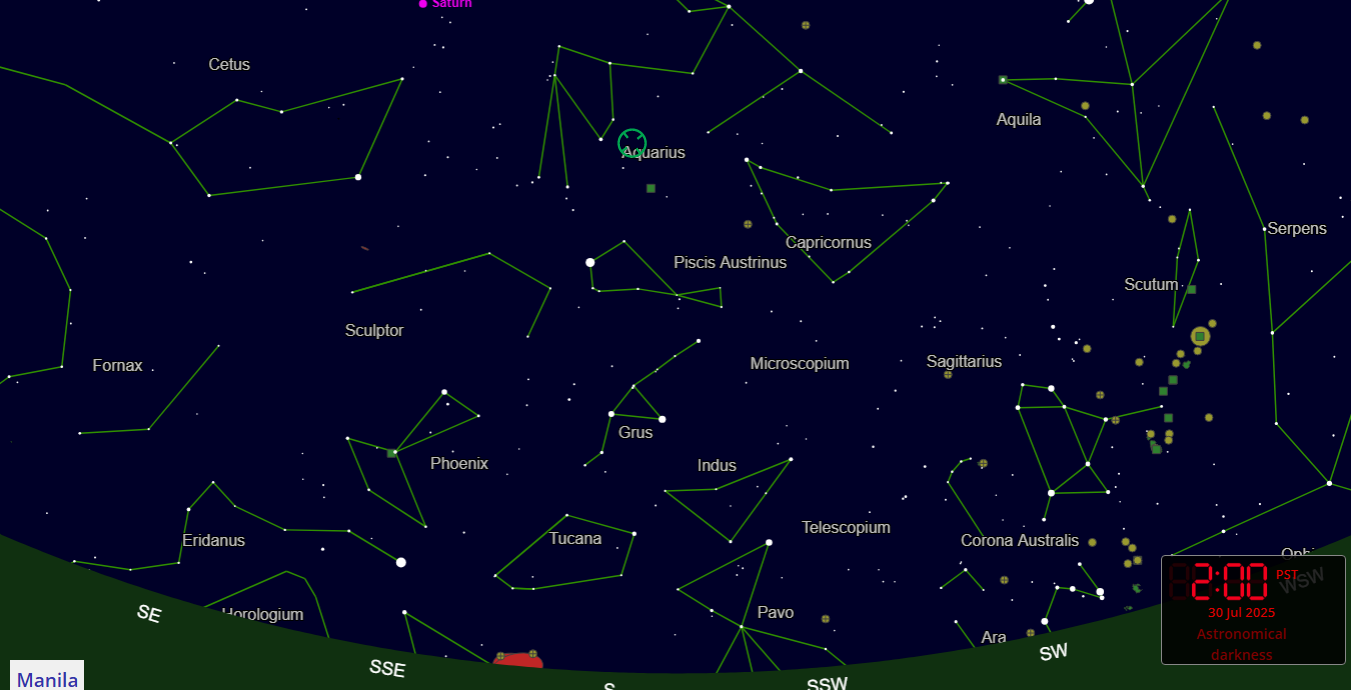 Figure 9: The view of the southern sky during the peak of the Southern δ-Aquariid meteor shower on 30 July 2025 at 02:00 a.m. when the shower’s radiant is represented by the green solid circle. |
Notes:
*following day
• All times displayed are in Philippine Standard Time (PhST)
References:
[1] PAGASA Special Publication No. 840; The Philippine Star Atlas 2019/Stellarium Software
[2] C. Guide, “Constellations: A Guide to the Night Sky.” https://www.constellation-guide.com/constellations-by-month/july-constellations/, Last accessed on 2025-06-19, 2025.
[3] Go Astronomy, “HERCULES CONSTELLATION” https://www.go-astronomy.com/constellations.php?Name=Hercules, Last accessed on 2025-06-19, 2025.
[4] Go Astronomy, “DRACO CONSTELLATION” https://www.go-astronomy.com/constellations.php?Name=Draco, Last accessed on 2025-06-19, 2025.
[5] Go Astronomy, “NORMA CONSTELLATION” https://www.go-astronomy.com/constellations.php?Name=Norma, Last accessed on 2025-06-19, 2025.
[6] Go Astronomy, “ARA CONSTELLATION” https://www.go-astronomy.com/constellations.php?Name=Ara, Last accessed on 2025-06-19, 2025.
[7] Multi-Interactive Computer Almanac (MICA), Last accessed on 2025-06-19, 2025.
[8] D. Ford, “In-The-Sky.org Guide to the night sky: “Objects in your sky: Planets” https://in-the-sky.org/data/planets.php, Last accessed on 2025-06-19, 2025.
[9] D. Ford, “In-The-Sky.org Guide to the night sky: “Mercury at highest altitude in evening sky” https://in-the-sky.org/news.php?id=20250704_11_100, Last accessed on 2025-06-19, 2025.
[10] D. Ford, “In-The-Sky.org Guide to the night sky: “Mercury at greatest elongation east” https://in-the-sky.org/news.php?id=20250704_11_101, Last accessed on 2025-06-19, 2025.
[11] D. Ford, “In-The-Sky.org Guide to the night sky: “Close approach of the Moon and Saturn” https://in-the-sky.org/news.php?id=20250716_15_100, Last accessed on 2025-06-19, 2025.
[12] D. Ford, “In-The-Sky.org Guide to the night sky: “Conjunction of the Moon and Saturn” https://in-the-sky.org/news.php?id=20250716_20_100, Last accessed on 2025-06-19, 2025.
[13] D. Ford, “In-The-Sky.org Guide to the night sky: “Conjunction of the Moon and Venus” https://in-the-sky.org/news.php?id=20250721_20_100, Last accessed on 2025-06-19, 2025.
[14] D. Ford, “In-The-Sky.org Guide to the night sky: “Close approach of the Moon and Mars” https://in-the-sky.org/news.php?id=20250728_15_100, Last accessed on 2025-06-19, 2025.
[15] D. Ford, “In-The-Sky.org Guide to the night sky: “Conjunction of the Moon and Mars” https://in-the-sky.org/news.php?id=20250728_20_100, Last accessed on 2025-06-19, 2025.
[16] D. Ford, “In-The-Sky.org Guide to the night sky: “α-Capricornid meteor shower 2025” https://in-the-sky.org/news.php?id=20250730_10_101, Last accessed on 2025-06-19, 2025.
[17] D. Ford, “In-The-Sky.org Guide to the night sky: “Southern δ-Aquariid meteor shower 2025” https://in-the-sky.org/news.php?id=20250730_10_100, Last accessed on 2025-06-19, 2025.
For more information, call or email:
Ms. Ma. Rosario C. Ramos
Chief, SSAS - RDTD
PAGASA - DOST
Diliman, Quezon City
Trunkline: 8284-0800 loc 3015, 3016, 3017
Email add: astronomy@pagasa.dost.gov.ph
- JULY 2025
- JUNE 2025
- MAY 2025
- APRIL 2025
- MARCH 2025
- FEBRUARY 2025
- JANUARY 2025
- DECEMBER 2024
- NOVEMBER 2024
- OCTOBER 2024
- SEPTEMBER 2024
- AUGUST 2024
- JULY 2024
- JUNE 2024
- MAY 2024
- APRIL 2024
- MARCH 2024
- FEBRUARY 2024
- JANUARY 2024
- DECEMBER 2023
- NOVEMBER 2023
- OCTOBER 2023
- SEPTEMBER 2023
- AUGUST 2023
- JULY 2023
- JUNE 2023
- MAY 2023
- APRIL 2023
- MARCH 2023
- FEBRUARY 2023
- JANUARY 2023
- DECEMBER 2022
- NOVEMBER 2022
- OCTOBER 2022
- SEPTEMBER 2022
- AUGUST 2022
- JULY 2022
- JUNE 2022
- MAY 2022
- APRIL 2022
- MARCH 2022
- FEBRUARY 2022
- JANUARY 2022
- DECEMBER 2021
- NOVEMBER 2021